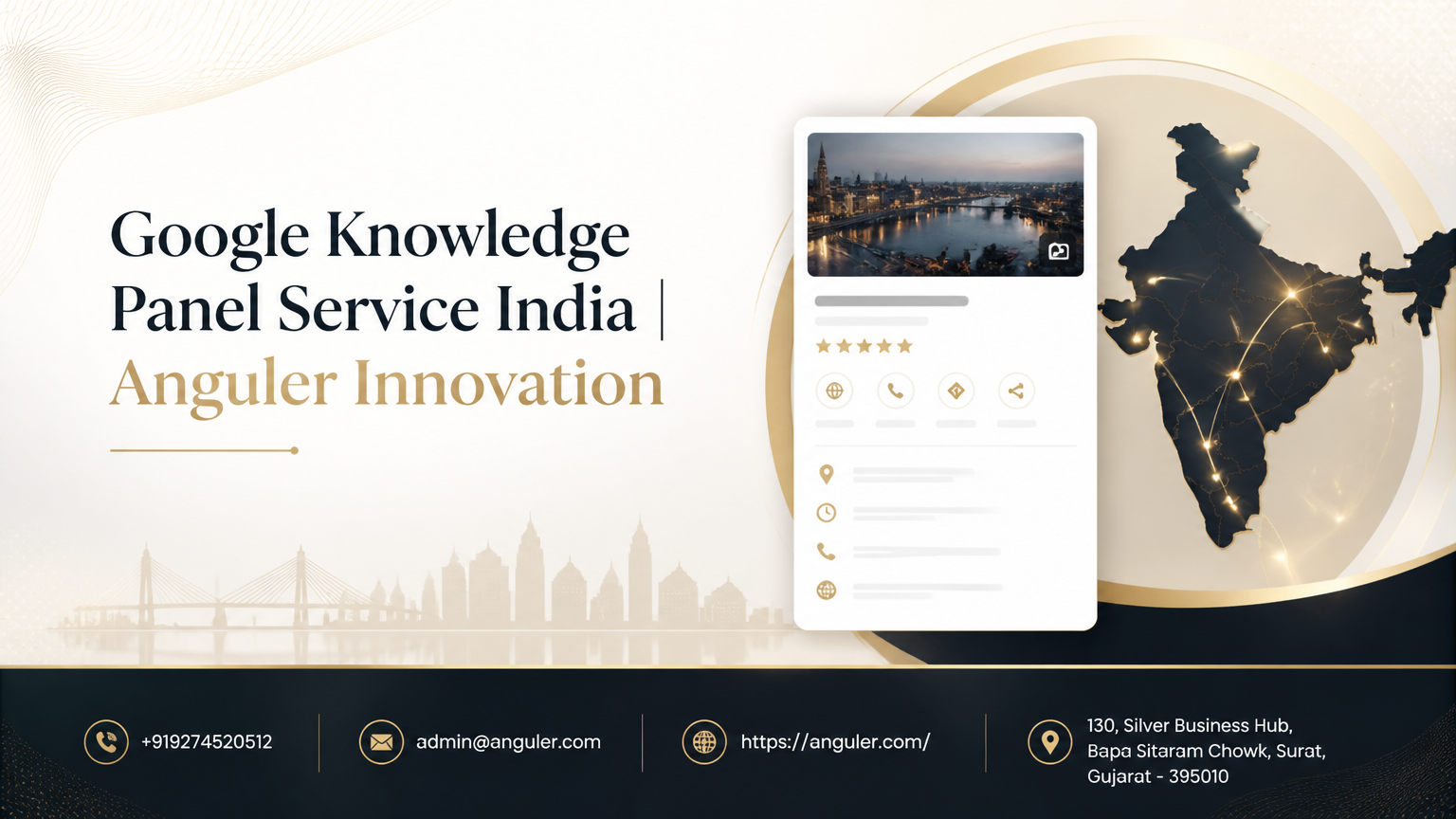
When someone searches your name or brand on Google, the information box on the right side of results can make or break a first impression. If that box is blank — or displaying inaccurate details — you lose credibility at the exact moment a prospect, investor, or journalist is evaluating you. According to a 2026 Kalicube study of over 45,000 companies, a full Knowledge Panel appears on only 34% of brand searches. For Indian founders, executives, and growing businesses, earning a verified panel through structured entity signals is no longer optional. This guide covers how Knowledge Panels work, who qualifies, and what a professional Google Knowledge Panel service in India should deliver.
TL;DR / Quick Answer
A Google Knowledge Panel is an auto-generated information box that Google displays based on data from Wikidata, Wikipedia, Schema.org markup and trusted third-party sources. It is not sold or granted by Google. For Indian brands and individuals, earning one requires building verifiable entity signals through schema, citations and authoritative media presence. A professional Google Knowledge Panel service in India manages this entity-building process — from discovery audit through verification — over a structured engagement.
1. What Is a Google Knowledge Panel and Why It Matters for Indian Brands
A Google Knowledge Panel is the structured information box that appears on the right side of Google Search when the algorithm identifies a distinct, verifiable entity — a person, business, organization, or creative work. Google auto-generates these panels through its Knowledge Graph, pulling data from sources like Wikidata, Wikipedia, Schema.org markup and authoritative third-party sites across the web. Crucially, these panels cannot be purchased from Google. They are earned through consistent entity signals, and Google's own documentation confirms that "not all knowledge panels are claimable."
For Indian brands, the Knowledge Panel is the single most visible trust signal in search results. It communicates instant legitimacy — displaying your logo, description, social profiles and key facts without requiring a single click-through. When we work with founders and growing businesses at Anguler Innovations on entity strategy, the gap between a blank sidebar and a populated panel translates directly into perceived authority. In a competitive market where a Google search frequently replaces a first meeting, that distinction carries measurable commercial weight.
2. Google Knowledge Panel Eligibility: Individuals, Businesses and Local Businesses
Not every entity qualifies for a Knowledge Panel, and understanding eligibility prevents wasted investment. Google recognizes three broad entity types: individuals (public figures, executives, authors, creators), organizations (companies, nonprofits, institutions), and local businesses (physical locations typically managed through Google Business Profile). Each type requires a different signal profile. An individual needs a consistent digital footprint across authoritative sources. An organization needs structured data on its website plus third-party citations. A local business may trigger a panel through Google Business Profile alone, though this produces a Local Knowledge Panel — a distinct variant from the entity-based panel most Indian brands pursue.
Eligibility does not depend on fame or revenue. A startup founder in India with strong schema markup, credible press coverage and consistent entity data across the web can earn a Knowledge Panel before a well-known brand that has done none of this groundwork. Our Google Knowledge Panel Entity Strategy services begin with a thorough eligibility audit — mapping your existing digital footprint against Google's entity signals to identify exactly which gaps must be closed. The guiding principle is simple: eligibility is constructed, not inherited.
3. How to Claim an Existing Google Knowledge Panel (Step-by-Step)
If a Knowledge Panel already exists for your entity but remains unverified, claiming it is the priority. Google's process: search your entity name, locate the panel, and click "Claim this knowledge panel." You will be prompted to sign in with a verified account linked to the entity — typically a YouTube channel, Google Search Console property, or a recognized social media profile. After identity confirmation, you submit suggested edits that Google reviews before granting verification access.
Claiming commonly hits friction for Indian entities. Mismatched name formats across social profiles, unverified Google Business Profiles, inconsistent address data between the panel and official registrations — all slow the process. Some panels remain unclaimable entirely because the entity lacks sufficient authoritative signals for Google to confirm identity. Professional guidance pre-aligns entity data before submission, avoiding repeated rejections. For panels displaying incorrect titles, missing logos, or outdated descriptions, the correction request runs through the same channel — though Google notes that all suggested edits are reviewed but never guaranteed. Consistency across verified sources remains the most reliable path to a successful outcome.
4. Building Knowledge Panel Signals from Scratch: Wikidata, Wikipedia, Schema and Citations
When no Knowledge Panel exists, entity construction requires foundational signal-building across four pillars: Wikidata entries, Wikipedia and wiki-style references, Schema.org markup on your website, and third-party citations from authoritative sources. Wikidata is Google's most direct entity data source — a structured, machine-readable database where accurate, properly referenced entries significantly increase panel likelihood. Wikipedia acts as Google's editorial validation layer. Kalicube's March 2026 data shows companies with a Wikipedia page appear in Knowledge Panels for roughly 52% of brand searches versus only 28% for those without — a near-doubling effect that makes editorial authoritativeness a decisive factor.
Schema markup and citations complete the picture. Organization, Person and LocalBusiness schema types tell Google's crawler precisely what your entity is, while press mentions, directory listings and industry profiles function as endorsement signals. Search Engine Land estimates Google may require approximately 30 endorsements from trusted sources before generating a panel. For Indian brands starting from scratch, the priority is earning credible media coverage from publications recognized in your industry. A disciplined entity reconciliation and structured data process builds these signals systematically over months — never through quick-fix tactics that risk long-term penalties.
5. India-Specific Schema Markup: Organization, LocalBusiness with GSTIN
While Schema.org fundamentals are universal, Indian entities carry unique identifiers that strengthen structured data when correctly implemented. The Organization schema type should include the official business name matching your Ministry of Corporate Affairs registration, the registered address in India-standard format, and — where applicable — the Director Identification Number (DIN). For GST-registered businesses, including the GSTIN as a supplemental identifier reinforces legitimacy across structured data ecosystems. Google's Knowledge Graph can cross-reference these codes against authoritative regulatory databases. That said, GSTIN alone does not trigger a Knowledge Panel — it functions as one supporting signal among many.
LocalBusiness schema carries particular weight for Indian companies with physical locations. Precise address data formatted to Indian postal standards — PIN codes, official state abbreviations, business hours in IST — helps Google distinguish your entity from similarly named businesses in India's high-density commercial landscape. For multi-location brands, implementing location-specific schema per branch with distinct geo-coordinates prevents entity fragmentation — a frequent oversight that dilutes rather than strengthens panel eligibility. All schema should be validated through Google's Rich Results Testing tool and the Schema Markup Validator before deployment to ensure clean, crawlable structured data across your site.
6. How to Evaluate Google Knowledge Panel Service Providers in India
The Indian market for Knowledge Panel services has matured, but provider quality varies significantly. When evaluating agencies, examine their own search presence first — an agency promoting Knowledge Panels without a verified panel itself signals a meaningful gap. Beyond self-representation, demand process transparency. Ethical providers explain clearly that Knowledge Panels cannot be bought from Google and outline a structured engagement covering entity audit, schema construction, Wikidata work, media placement and verification management. Any agency promising a "panel in 7 days" should be approached with significant caution.
Red flags include providers relying solely on Google Business Profile for entity-based Knowledge Panels, using fabricated citation sources, or lacking a post-verification maintenance framework. The strongest Indian agencies combine structured data expertise with PR capability — never one without the other. Our Vanguard Founder Authority Case Study demonstrates how a unified approach to executive positioning and entity building produces verifiable search presence across Google's ecosystem. When shortlisting providers, request case studies, ask specifically about their Wikidata methodology, and confirm they follow Google's official verification protocol rather than workarounds that risk long-term entity penalties.
7. Pricing Models for Google Knowledge Panel Services in India
Pricing varies based on the scope of entity-building work required, and understanding the common models helps set realistic expectations. The two predominant structures are retainer-based engagements and project-scope quotes. A retainer — typically running 3 to 6 months — covers entity audit, schema implementation, Wikidata and citation building, media outreach and verification management. This model suits brands and founders needing comprehensive entity construction from scratch. Project-scope pricing applies to narrower work: claiming an existing panel, correcting data, or implementing schema without broader media outreach. Both models are quoted after initial consultation based on the complexity of the entity's current digital footprint.
A critical note on transparency: no legitimate agency publishes fixed Knowledge Panel prices because scope varies too heavily between a founder with zero digital presence and a mid-stage company with partial signals already built. GST at the prevailing professional services rate applies to agency fees as standard. When evaluating quotes alongside client success stories, prioritize demonstrated methodology over lowest bid. Agencies that cut corners on Wikidata accuracy or skip schema validation create entity debt that costs significantly more to repair. Transparent scoping during the discovery phase remains the most reliable indicator of a trustworthy engagement.
8. Timeline, Success Rate and Risks of Hiring an Indian Knowledge Panel Agency
The most common question from Indian founders: "How long until I get a Knowledge Panel?" The honest answer is that no agency can guarantee a specific timeline because Google alone controls panel generation. For a new engagement starting from minimal online presence, 8 to 16 weeks is realistic for initial signals to take effect, with the panel appearing anywhere from week 12 to week 24. Entities with partial signals — an existing Wikidata entry, some press coverage, basic schema — can see results compress to 4 to 10 weeks. Google's official documentation states panels are auto-generated and suggested edits are reviewed but never guaranteed.
The real risks are operational. Providers who fabricate Wikidata entries without proper references, submit inaccurate schema, or source citations from disreputable domains can trigger quality signals that delay or block panel generation entirely. Overpromising remains the most common danger — agencies guaranteeing outcomes without disclosing the probabilistic nature of the Knowledge Graph misalign with how Google's system actually works. Our Knowledge Panel FAQ and timeline answers cover what to realistically expect from a structured engagement. The guiding mindset: treat this as a long-term authority investment, not a transactional purchase with guaranteed deliverables.
9. Ongoing Maintenance: Monitoring, Correction and AI-Answer Alignment
Earning a Knowledge Panel is not the finish line — it marks the beginning of ongoing maintenance obligations. Google's Knowledge Graph updates continuously, meaning your panel can change without notice. Outdated descriptions, incorrect logos, wrong social links, and entity merges — where Google conflates two similarly named entities — are common post-verification issues. Regular monitoring through branded search is the minimum baseline. Professional services go further, tracking changes across Wikidata, checking for schema drift on your website, and maintaining citation freshness across the third-party sources feeding the Knowledge Graph.
The factor Indian brands must not ignore in 2026 is AI-answer alignment. Tools like Google Gemini, ChatGPT and Perplexity draw entity data from the same Knowledge Graph that generates Knowledge Panels. An inaccurate or absent panel doesn't just affect search results — it shapes how AI engines describe your brand in conversational answers. This makes Knowledge Panel maintenance a dual-purpose investment covering both traditional search visibility and emerging AI-driven discovery. For brands investing in entity work, treating the Knowledge Panel as a living digital asset — with quarterly audits, schema validation and citation freshness checks — is the approach that builds durable authority over time.
10. How to Choose the Right Knowledge Panel Service in India
Selecting the right provider comes down to five non-negotiable criteria. First, methodology transparency — the agency must explain its process openly and never promise guaranteed outcomes. Second, dual competency in PR and structured data, because entity building demands both editorial credibility and technical implementation. Third, proven case studies demonstrating real entity work with real businesses. Fourth, ethical practices aligned with Google's official verification guidelines. Fifth, a structured engagement model with defined phases, deliverables and accountability — not open-ended retainer loops.
At Anguler Innovations, we operate at the intersection of strategic PR and technical entity engineering — a dual-division model that eliminates the fragmentation founders face when coordinating separate agencies for media work and structured data. Our six-phase process runs from discovery audit through continuous optimization, with every deliverable tailored to the entity's actual position in Google's ecosystem. Whether you are an individual pursuing verified entity recognition or a growing brand building comprehensive search visibility, the right provider makes the engagement transparent from day one. Ready to see where your entity stands? Schedule a Knowledge Panel consultation to assess your current signals and discuss what it takes to get recognized.
Conclusion
A Google Knowledge Panel is the earned outcome of consistent, verifiable entity building — never a product you can purchase directly. For Indian brands, founders and executives in 2026, the path runs through structured schema, Wikidata, credible media citations and disciplined verification management. The brands investing in this work today will own the search sidebar — and increasingly, the AI-generated answers — for years to come. If your current search results do not reflect who you really are, the signal work starts now.
Start your digital authority transformation today by partnering with Anguler Innovations, or reach out directly to our entity team via Contact Us.
11. Frequently Asked Questions
A Google Knowledge Panel service in India is an agency-led engagement that audits your digital footprint, builds structured entity signals through Schema.org markup and Wikidata, secures authoritative citations from trusted sources, and manages Google's verification process to help you earn a verified Knowledge Panel in search results.
No. Google does not sell or grant Knowledge Panels. They are auto-generated by the Knowledge Graph based on trusted entity signals from the open web. Any agency claiming to sell panels directly is operating outside Google's guidelines.
Timelines depend on your current digital presence. New entity-building engagements typically take 8 to 24 weeks for the panel to appear. Entities with partial signals — existing Wikidata entries, some press coverage, basic schema — can see results in 4 to 10 weeks.
A Google Business Profile supports Local Knowledge Panel visibility for businesses with physical locations. However, the entity-based Knowledge Panel that brands and individuals typically pursue requires additional signals including Wikidata, Schema.org structured data and authoritative citations beyond GMB.
The primary risks include overpromising timelines, fabricated Wikidata entries without proper references, inaccurate schema submissions, and citations sourced from low-quality domains. These can delay or block panel generation. Evaluate agencies on transparency and methodology rather than guaranteed outcomes.
AI tools like Google Gemini, ChatGPT and Perplexity pull entity data from the same Knowledge Graph that generates Knowledge Panels. An accurate, verified panel improves how AI engines describe your brand conversational — making Knowledge Panel maintenance a dual-purpose investment covering both traditional search and AI-driven discovery.
Related Guides & Insights
Digital PR Agency India: 2026 Guide →
Complete guide for founders on editorial coverage, backlinks & AI search visibility.
Anguler Innovations: Digital Authority & Tech Agency →
Discover how our dual-division PR + Tech model replaces fragmented agencies.